Chloe Acland

Fera Science Shortlisted for National Potato Industry Innovation Award

Fera is pleased to announce that it has been named a finalist for the Potato Review's National Potato Industry Awards under the category of Innovation

Covering six categories, the awards offer a platform for growers, agronomists and suppliers to the industry to demonstrate a commitment to raising industry standards. The judges are looking for organisations that have made a significant contribution to the overall success of the potato industry.

After championing the Industry Innovation Award back in November 2019, this year’s submission focusses on the fantastic work that the in-house Nematology team have done to develop a new commercial test that can provide valuable management information on soil health and the wider cropping system.

The 'Nematodes as bio-indicators of Soil Health’ analysis uses Fera's expert identification capabilities to classify nematodes into functional groups that go beyond the traditional plant pathogenic species; including fungivores, bacterivores and predators.

The balance and structure of these functional groups in a soil sample can provide significant insight into the impact — and effectiveness — of management practices on soil health and help support decisions about cropping rotations, cover crop mixes and nutrient use.

In the first season of offering, Fera's Nematodes a bio-indicators of Soil Health analysis has provided insight into the effectiveness of nutrient regimes, highlighting the need for slower release fertiliser and has also informed the longer-term cover crop mix as part of a multi-year IPM strategy. The outputs from the analysis can also help to provide valuable information on soil biodiversity and ecosystem health, which can be used to evidence best practice and environmental stewardship.

In addition, Fera Science would like to congratulate A.H Worth & Co on its nomination as a finalist in the Environment category of the National Potato Industry Awards. The nomination highlights the commitment and progress made by A.H Worth & Co in their role as an Indicator and Innovation Farm in the M&S Farming with Nature programme within which Fera Science are a science delivery partner.

Award winners will be announced on the 24th of November at the 2021 National Potato Industry Awards in Harrogate, after the first day of the British Potato 2021 event. Fera is proud to be a finalist of the Awards and looks forward to joining the company of like-minded business from the potato industry.

Join Fera Science at the BP2021 event between 24th-25th November, located at stand 196, where Science leads from the nematology, entomology, virology, and remote sensing teams will be on hand to demonstrate their Potato expertise.

Fera Science will also be exhibiting at CropTec in Peterborough on stand 1.32 between 24th-25th November.

In-field aphid monitoring with yellow water traps – seed potatoes

Following consultation with existing customers and stakeholders, we’re pleased to confirm that Fera will be providing its industry-critical aphid monitoring programme for the 2022 season utilising the same reporting and alert platform as previous years.

We are offering the same service, including up to 10 samples analysed per trap site. The service will include provision of a trap, provision of sample pots to return samples to us in, and provision of reply-paid envelopes. We will require your permission to publish results anonymously as is done currently and to map these as we do now. You can see how this is done here. You will have the option to opt in to this. Only people who are paying for the service will have access to the website.

The cost for this service will be £500 (exc. VAT) per trap site per season, payable in advance prior to submitting the first sample. You will be able to place orders for this service via our website and pay by card.

The original service, which started in 2004, was supported with levy board funding and we have been working with AHDB to coordinate a smooth transition into the forthcoming season.

If you have any questions about this service, please contact us at: [email protected].


Click here to register your interest for the programme to receive updates and alerts. 

Fera Science Welcomes Defra’s Response to the Public Consultation on Novel Genetic Technologies

Fera Science Ltd welcomes Defra’s recent publication of its response on behalf of Government to the public consultation on novel genetic technologies, such as gene editing1.

At Fera, we consider that gene editing (and other novel breeding techniques) has the potential to benefit agriculture in terms of sustainable and resilient production, improved yields and better crops and that, with appropriate oversight, these technologies present no greater risk than currently used crop breeding methods. The anticipated high level of adoption of gene editing globally and potential legislative changes in the EU2, underline the importance for the UK to revisit regulation around novel genetic improvement technologies now.

As we state in our response to the consultation3, we welcome the cautious and incremental approach the government is taking in suggesting revisions to the regulation of gene editing, as this gives time to build confidence and deploy commensurate safety and related measures along the way. We particularly welcome the Government’s commitment to further public engagement and, in-line with the recent study by the FSA4, we believe that further public outreach over gene editing will be required to better inform public opinion. We consider it important that any legislative changes continue to carefully consider the importance of food labelling for consumer choice and we note that detection of future gene edited products remains an area of considerable challenge, emphasising the importance of traceability within the food chain.

Fera’s response to the consultation is found here


1https://www.gov.uk/government/consultations/genetic-technologies-regulation/outcome/genetic-technologies-regulation-government-response#summary-of-consultation-views-and-our-response

2 https://ec.europa.eu/info/law/better-regulation/have-your-say/initiatives/13119-Legislation-for-plants-produced-by-certain-new-genomic-techniques_en

3 https://www.fera.co.uk/news/fera-science-gene-editing-consultation-response/

4 https://www.food.gov.uk/research/research-projects/consumer-perceptions-of-genome-edited-food

Join us at Fruit Focus 2021


Fruit Focus is back for 2021!

Join us at the event


As the UK's premier technical event for the fruit industry, Fruit Focus attracts an increasing number of visitors year on year, bring together more than 1,200 growers and industry professionals.

Over 115 leading suppliers exhibit at Fruit Focus every year as the event provides a unique opportunity to update on the latest technology and industry developments. It showcases all aspects of agronomy, machinery and equipment, business information, pre and post-harvest technology, and marketing. Fruit Focus also provides those in the industry an oppotunity to exchange views and network with fellow producers. As well as soft and orchard fruit, vines also feature at Fruit Focus.

Our experts will be on hand to discuss your crop health questions and requirements, so if you are attending Fruit Focus this year then come and see us.

See how we can help you...


Crop Testing

We are world renowned for providing excellence in crop testing and diagnostic services offering the most comprehensive range of services throughout all sectors of the supply chain. Our leading expertise and outstanding facilities can help you understand and identify your agricultural challenges; helping you to deliver more economically and environmentally resilient farming solutions for the sustainable intensification of arable systems.


Nematology Testing

Fera's team of nematode experts provide a unique free-living nematode identification service, and offers nematode detection and consultancy advice for all sectors of agriculture and horticulture potentially reducing yield loss.


Soil Health

We are helping growers and industry to understand how different soil properties influence the development and spread of pests and diseases. We help by developing more effective soil-management strategies to mitigate these risks.


Insect Monitoring

Our team of world leading entomologists offer multidisciplinary expertise in terms of design and management of insect monitoring schemes. This ensures your crop management strategy is fit for purpose and is able to address any potential viruses within your crop, mitigating the potential economic risk to your harvest.


Join us at Fruit Focus 2019 and register today

Click here for more information and to register for this event


Fera's Plant Clinic is Proud to be Supporting Plant Health Week in the UK

Plant Health Week: 10th - 16th May 2021

As part of Plant Health Week 2021, Fera is proud to highlight the role it has played in the protection of plants from harmful pest and diseases in the UK, over many years. 

As the National Reference Laboratory for Plant Health in England and Wales, Fera plays a key role in protecting the UK against the introduction and spread of harmful pests and diseases, providing diagnostic testing for both the UK plant health service and directly to UK growers. Over the last 12 months, Fera has examined nearly 24,000 samples and performed over 33,000 tests on behalf of the plant health service. These samples are from inspections carried out on imported plants and produce; from surveillance for pests and diseases on plants in horticulture, agriculture and the wider environment; and in support of exports of UK plants and produce.

In addition to the work for the UK plant health service, Fera is also able to provide support directly to industry, through it's UK leading Plant Clinic and, during the same period, Fera tested a further 2800 samples sent directly by growers.

Outside of UK work, Fera provides diagnostic support further afield; biodiversity in the UK Overseas Territories (UKOTs) is globally significant and is recognised as being under threat from invasive alien species. Preventing the establishment of invasive alien species in the UKOTs is a strategic priority for the UK Government, and Fera has led a Defra-funded project to provide an identification service for invasive invertebrate plant pests for the UKOTs since November 2009. The last year has been difficult, with COVID restrictions hampering the taking and posting of samples from these territories, but Fera still received 233 samples from six territories (Ascension Island, Cayman Islands, Falkland Islands, Montserrat, Saint Helena and South Georgia) and examined 585 individual specimens and photographs that were found in association with 65 plant species. At least 125 invertebrate species were identified, with new records found on two islands, including two major new invasive plant pests.

Fera is pleased to see how public awareness of plant health has increased over recent years and fully supports the wide range of activities taking place during UK Plant Health Week.

Fera Provides Greater Protection for Sweet Chestnut Trees in England, in Partnership with Defra

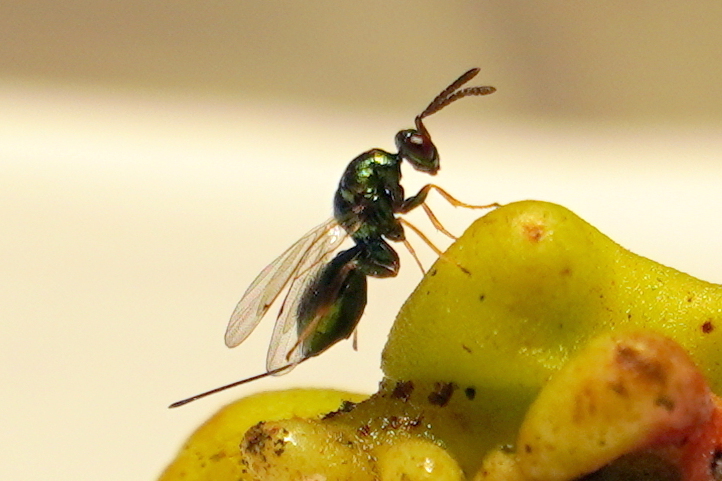
Credit: Dr Chris Malumphy, Fera Science Ltd. Image Credit: Dr Chris Malumphy, Fera Science Ltd.

Fera is proudly stepping up the fight against an invasive tree pest of sweet chestnut trees, the Oriental Chestnut Gall Wasp, as announced by the UK’s Chief Plant Health Officer.

Working with the Department for the Environment Food and Rural Affairs (Defra), Fera will sensitively control the release of a biological control agent, a parasitoid wasp called Torymus sinensis, to help reduce the spread of Oriental Chestnut Gall Wasp in England in the efforts to protect the health of sweet chestnut trees.

The control agent release has been approved following extensive research, a thorough risk assessment, and careful testing, commissioned and conducted by Fera in partnership with Defra, to ensure the safe, controlled release of the parasitoid in the UK.

Senior Scientist at Fera Science Ltd Neil Audsley said:

Following an extensive programme of research and thorough risk assessment, we are now able to release a biological control 

agent to reduce the population of Oriental Chestnut Gall Wasp. Biological control is the safest and most effective means to manage pests such as Oriental Chestnut Gall Wasp. This strategy has been successfully used in countries across Europe and will directly contribute to improving the health of sweet chestnut trees in England.

The Oriental Chestnut Gall Wasp was first found in England in 2015. The wasp causes damage through galls on the buds and leaves of the sweet chestnut tree. In high numbers, the gall wasp can weaken sweet chestnut trees and make them more vulnerable to other pests and diseases, including Sweet Chestnut Blight.

The biological control agent, Torymus sinensis, is already present naturally in England but in very low numbers and further releases of the parasitoid will enable the tree population to increase to a level that will effectively control Oriental Chestnut Gall Wasp. This method of biological control is used successfully in many countries across Europe.

Fera will follow the release with a programme of monitoring for the next 10 years to carefully regulate the biological control, having gained governmental approval after robust scientific review, including by the Advisory Committee on Releases to the Environment and a public consultation.

Chief Plant Health Officer Nicola Spence at Defra said:

Threats to sweet chestnut trees have increased as a result of tree pests and diseases such as Oriental Chestnut Gall Wasp and Sweet Chestnut Blight. The release of this biological control agent represents a huge step towards protecting the health of sweet chestnut trees and will further enhance the resilience of our treescape.”

The release of Torymus sinensis is part of the government’s long-term strategic response to managing threats from tree pest and diseases to achieve the goals of the Tree Health Resilience Strategy (2018). Working in partnership with world leading scientists and researchers, Fera, in partnership with Defra will continue to protect England’s sweet chestnut trees from existing and emerging threats.

Fera Science Gene Editing Consultation Response

The UK government has opened a consultation into the regulation of gene editing in the UK, and into wider revisions for the GM regulations. These changes will affect us all, as citizens as well as scientists.

As an organisation that works across the food, agriculture and environment sectors, Fera can see considerable benefits arising from the judicious use of gene editing technology, for example by transferring desirable traits between varieties of the same species faster than current breeding methods, and arguably with less loss of genetic variation and fewer risks from accidental DNA changes elsewhere in the genome (off target mutations). We believe that with appropriate oversight, these technologies can offer great benefits and no greater risk than currently used methods. However, we acknowledge the novelty of the technology and the potential lack of awareness in the general public of the nature of gene editing, and so advocate a considered approach.

We consider that animals or plants that have been gene edited in such a way as to be indistinguishable from traditionally bred animals or plants should not be regulated under GM regulations. We take this position because individually, they don’t differ from plants or animals that were created using traditional breeding and therefore the risks should be no greater. This lack of difference gives a practical reason why these gene edited plants and animals will be difficult to regulate, as reliable detection of gene edited over traditional will be problematic, making enforcement difficult. Where consumer choice makes segregation of produce containing gene edited produce desirable, industry and Government will need to use the security of the supply chain and associated chain of custody to do so, an existing strength of Great Britain.  

On the topic of the wider revisions to the regulations around GM, Fera would welcome a government review of regulations around all novel or higher risk crop and livestock traits on environment, not only those produced through GM or GE. We will act in partnership with Govt and other institutions to enable this change.

Many of the prime issues are around how much, as a country, we wish to use and exploit gene editing (and GM more generally). We welcome wider engagement with the general public, of which we hope this consultation will be the start; these revisions will have real term impacts on the food we eat and crops we cultivate. The public must be aware of the impacts and have the opportunity to make informed choices over their wish for labelling and regulation. As with GM regulations in the past, Government and industry should champion consumer choice where the public wish to exert this choice. Click here to read our full response to the consultation.